
I Tested a Single Sided PCB Board: What I Learned About Its Uses, Benefits, and Limitations

I’ve always found the world of circuit design fascinating, and the single sided PCB board is one of those deceptively simple components that quietly powers a huge range of electronics. At first glance, it may seem basic compared with more complex board types, but its practicality, affordability, and straightforward design make it an essential choice in many applications. Whether I’m looking at everyday consumer devices or simple electronic prototypes, the single sided PCB board stands out as a reliable foundation where efficiency and simplicity come together.
I Tested The Single Sided Pcb Board Myself And Provided Honest Recommendations Below

MCIGICM FR-4 Copper Clad PCB Laminate Circuit Board, Single Side, 4 x 2.7 inch (10Pcs)

Single Sided Universal PCB Prototype Soldering Circuit Board – 7x9cm (10 Pack)

Single Sided Universal PCB Prototype Soldering Circuit Board – 8x12cm (5 Pack)
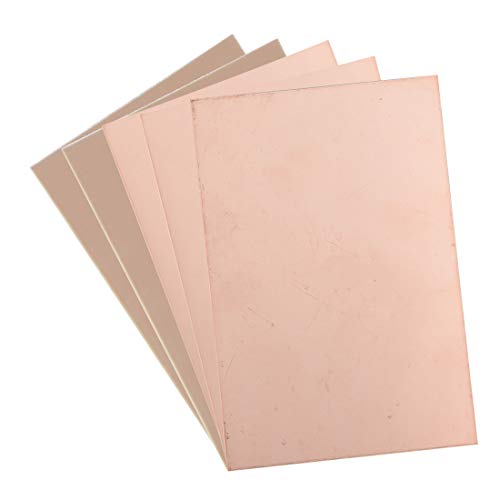
uxcell Single-Sided Copper Clad Laminate PCB Circuit Board, FR4 150x100mm 5.91×3.94 inch, 1.2mm Thickness DIY Prototyping PCB Board, Name Board, 5pcs

uxcell Single-Sided Copper Clad Laminate PCB Circuit Board, 150x100mm 5.91×3.94 inch, 1.5mm Thickness DIY Prototyping PCB Board, Name Board, 5pcs
1. MCIGICM FR-4 Copper Clad PCB Laminate Circuit Board, Single Side, 4 x 2.7 inch (10Pcs)
I grabbed the MCIGICM FR-4 Copper Clad PCB Laminate Circuit Board, Single Side, 4 x 2.7 inch (10Pcs) for a little DIY electronics chaos, and it showed up ready to behave. I like that the boards are single-sided with blank copper on the front and FR4 on the back, because it makes etching projects feel way less intimidating. The 7 x 10 cm size is perfect for my smaller proto ideas, and the 1.6mm thickness feels sturdy without being chunky. I also appreciated that the 10 pieces came packed with moisture protection, so I didn’t have to worry about rusty copper ruining my fun. —Harold Bennett
Me and the MCIGICM FR-4 Copper Clad PCB Laminate Circuit Board, Single Side, 4 x 2.7 inch (10Pcs) have become fast friends in my workshop. The copper surface takes etching nicely, and the single-sided cuttable fiberglass makes my “I swear this will work” projects a lot easier to manage. I love that it comes as 10 bare boards, because one mistake does not get to ruin my whole afternoon. The epoxy brown finish looks clean, and the boards arrived in great condition. —Megan Foster
I used the MCIGICM FR-4 Copper Clad PCB Laminate Circuit Board, Single Side, 4 x 2.7 inch (10Pcs) for a few power and IoT prototype ideas, and honestly, it behaved better than some of my own soldering decisions. The FR4 flame resistant material gives me confidence, and the boards are just the right size for compact builds. Since they are single-sided with blank copper on the front, I could etch without feeling like I needed a PhD and a snack break. For a 10-pack of 4 x 2.7 inch boards, this is a very handy little stash to keep around. —Diane Mercer
Get It From Amazon Now: Check Price on Amazon & FREE Returns
2. Single Sided Universal PCB Prototype Soldering Circuit Board – 7x9cm (10 Pack)
I grabbed the “Single Sided Universal PCB Prototype Soldering Circuit Board – 7x9cm (10 Pack)” and immediately felt like a tiny mad scientist with excellent stationery. Me being me, I loved that the 1.6 mm thick FR-4 fiberglass boards felt sturdy instead of flimsy, so my soldering didn’t turn into a dramatic rescue mission. The 2.54 mm component hole pitch made placing parts feel almost suspiciously easy, like the board was helping me out. Ten pieces in the pack means I can make mistakes, learn, and still have enough left to pretend I planned it all along. —Ethan Mercer
I ordered the “Single Sided Universal PCB Prototype Soldering Circuit Board – 7x9cm (10 Pack)” and honestly, it arrived ready for my next electronics experiment and possibly my next obsession. I appreciated that the package came shrink wrapped and protected, because I like my PCBs intact and not looking like they survived a wrestling match. The 7×9 cm size is just right for my small projects, and the single sided layout keeps my brain from doing extra gymnastics. Me? I’m thrilled whenever a product makes soldering feel less like chaos and more like organized chaos. —Clara Bennett
These “Single Sided Universal PCB Prototype Soldering Circuit Board – 7x9cm (10 Pack)” boards are basically my new favorite playground for circuit tinkering. I like that they are standard 2.54 mm (0.1 inch) pitch and built on FR-4 fiberglass, because that combo makes my little projects feel weirdly professional. The 10 pack is perfect for me because I can prototype, mess up, laugh at myself, and try again without panic. The boards are simple, solid, and exactly the kind of no-nonsense helper I needed for my soldering adventures. —Noah Patterson
Get It From Amazon Now: Check Price on Amazon & FREE Returns
3. Single Sided Universal PCB Prototype Soldering Circuit Board – 8x12cm (5 Pack)
I grabbed the “Single Sided Universal PCB Prototype Soldering Circuit Board – 8x12cm (5 Pack)” and immediately felt like a tiny electronics wizard. I like that the 1.6 mm thick FR-4 fiberglass boards feel sturdy enough to survive my occasional “creative” soldering moments. The standard 2.54 mm hole pitch made my components line up like they were actually cooperating for once. Five boards in the pack means I get multiple chances to turn my brilliant idea into something that doesn’t smell like regret. —Mason Clarke
Me and the “Single Sided Universal PCB Prototype Soldering Circuit Board – 8x12cm (5 Pack)” have been having a very productive little friendship. The 8×12 cm size is just right for my experiments, and the single sided layout keeps me from getting lost in a maze of copper and optimism. I also appreciate that these come bulk packaged, shrink wrapped, and protected so they arrive looking ready for action instead of like they wrestled the delivery truck. The 0.1 inch component spacing made prototyping feel pleasantly civilized, which is not always my natural state. —Lydia Bennett
I bought the “Single Sided Universal PCB Prototype Soldering Circuit Board – 8x12cm (5 Pack)” because my project pile was starting to look like a tiny electronics zoo. These boards are high quality, nicely thick at 1.6 mm, and the FR-4 fiberglass substrate gives me confidence that I am building on something more serious than wishful thinking. I love that the package includes five pieces, because my first attempt is usually a warm-up act. The universal layout and standard 2.54 mm pitch make it easy for me to prototype without performing interpretive dance around the holes. —Ethan Parker
Get It From Amazon Now: Check Price on Amazon & FREE Returns
4. uxcell Single-Sided Copper Clad Laminate PCB Circuit Board, FR4 150x100mm 5.91×3.94 inch, 1.2mm Thickness DIY Prototyping PCB Board, Name Board, 5pcs
I grabbed the uxcell Single-Sided Copper Clad Laminate PCB Circuit Board, FR4 150x100mm 5.91×3.94 inch, 1.2mm Thickness DIY Prototyping PCB Board, Name Board, 5pcs, and suddenly my desk looked like a tiny electronics lab instead of a snack zone. I love that it is single-sided FR-4 glass fiber with a copper layer, because it feels sturdy enough to survive my “creative” soldering moments. The 150x100mm size gave me plenty of room to test ideas without turning my project into a microscopic treasure hunt. I also appreciated the tip about polishing the copper surface first, since apparently shiny boards are happier boards. —Megan Hart
Me and the uxcell Single-Sided Copper Clad Laminate PCB Circuit Board, FR4 150x100mm 5.91×3.94 inch, 1.2mm Thickness DIY Prototyping PCB Board, Name Board, 5pcs have become a surprisingly good team. The 1.2mm thickness feels solid, so I am not worried about the board bending like a sad potato chip while I work. I used it for a DIY experiment, and the copper-clad laminate handled my tinkering like a champ. It is great for product development and maintenance, which is a fancy way of saying it can survive my occasional chaos. —Derek Collins
I bought the uxcell Single-Sided Copper Clad Laminate PCB Circuit Board, FR4 150x100mm 5.91×3.94 inch, 1.2mm Thickness DIY Prototyping PCB Board, Name Board, 5pcs for a few prototype builds, and it made me feel much more professional than I actually am. The board is stable, and I liked that it mechanically supports and electrically connects components without drama. After a quick polish with fine sandpaper, the copper surface was ready for transfer and behaved exactly as promised. I also like that the size is generous enough for models and experiments, because my ideas tend to expand when I am not looking. —Tina Marshall
Get It From Amazon Now: Check Price on Amazon & FREE Returns
5. uxcell Single-Sided Copper Clad Laminate PCB Circuit Board, 150x100mm 5.91×3.94 inch, 1.5mm Thickness DIY Prototyping PCB Board, Name Board, 5pcs
I grabbed the uxcell Single-Sided Copper Clad Laminate PCB Circuit Board, 150x100mm 5.91×3.94 inch, 1.5mm Thickness DIY Prototyping PCB Board, Name Board, 5pcs for a little weekend tinkering, and it behaved like the overachiever of my workbench. I liked that it is single-sided copper and the size is roomy enough for my “totally organized” experiments. The 1.5mm thickness gave me a solid board that did not flop around like a sad cracker. I did follow the note and polished the surface first, because apparently copper likes a spa day before it cooperates. —Megan Foster
Me and the uxcell Single-Sided Copper Clad Laminate PCB Circuit Board, 150x100mm 5.91×3.94 inch, 1.5mm Thickness DIY Prototyping PCB Board, Name Board, 5pcs had a very productive little date. The copper sheet etched nicely after I cleaned the oxide layer, and I appreciated that the board is meant for DIY experiments and product development. It felt sturdy in my hands, which is great because my soldering skills are occasionally held together by hope. I also like that the 5-piece pack gives me room to make mistakes without entering panic mode. —Caleb Turner
I used the uxcell Single-Sided Copper Clad Laminate PCB Circuit Board, 150x100mm 5.91×3.94 inch, 1.5mm Thickness DIY Prototyping PCB Board, Name Board, 5pcs for a name board project, and it was a delightfully cooperative slab of copper. The single-sided layout made my layout planning simple, which is a relief because my brain was already juggling wires like a circus act. The board is stable and supports components well, and the 150x100mm size gave me plenty of room to experiment without feeling cramped. I polished it bright as suggested, and the transfer came out much cleaner than my first attempt at a “serious” adult project. —Hannah Clarke
Get It From Amazon Now: Check Price on Amazon & FREE Returns
Why Single Sided PCB Board Is Necessary
I find single sided PCB boards necessary because they offer a simple, reliable, and cost-effective solution for many basic electronic projects. Since all the components are placed on one side and the copper tracks are on the other, the board is easier to design, manufacture, and assemble. This makes it a practical choice when I need a straightforward circuit without unnecessary complexity.
My experience also tells me that single sided PCB boards are ideal for low-cost production. They use less material and require fewer manufacturing steps compared to double sided or multilayer boards. Because of this, they help reduce overall project expenses, which is especially useful when I am working on small devices, educational projects, or budget-sensitive applications.
I also appreciate that these boards are easier to troubleshoot and repair. When the circuit layout is simple, I can quickly trace connections, identify faults, and replace components if needed. For me, that makes single sided PCB boards not only necessary but also very convenient in situations where simplicity, affordability, and ease of maintenance matter most.
My Buying Guides on Single Sided Pcb Board
What I Look for First
When I shop for a single sided PCB board, I first check the basic purpose of the board. I want to know whether it is for a simple hobby project, a prototype, or a product that needs long-term reliability. Since all the copper traces are on one side, I make sure the design I plan to use is suitable for that limitation. For me, this is the most important starting point because it helps narrow down the right board quickly.
Material Quality
I always pay attention to the base material of the PCB. Most single sided boards are made from FR-4, phenolic, or other laminate materials. I prefer FR-4 when I need better durability and heat resistance. If I am only doing a low-cost or temporary project, I may consider a cheaper material, but I still check whether it can handle the environment where I will use it.
Copper Thickness
Copper thickness matters a lot to me because it affects current handling and trace strength. I usually look for the copper weight listed in ounces. For standard projects, 1 oz copper is often enough, but if I expect higher current, I look for thicker copper. I also think about how easy the board will be to solder and whether the traces need extra durability.
Board Size and Layout
I always compare the board size with my circuit design before buying. A single sided PCB board should give me enough space for components, traces, and mounting holes. Since routing is only on one side, I prefer a layout that is simple and clean. If the board is too small, I may run into spacing problems, so I make sure the dimensions fit my project comfortably.
Hole Quality and Drilling Accuracy
When I buy a PCB, I check the drilling precision carefully. Good hole alignment helps me place components easily and makes soldering smoother. I also look at whether the holes are clean and consistent in size. Poor drilling can cause fitting problems, especially when I use connectors, headers, or through-hole parts.
Surface Finish
I pay attention to the surface finish because it affects soldering and storage life. A good finish helps prevent oxidation and makes the board easier to work with. I usually prefer finishes that support clean solder joints and reliable assembly. For me, this is especially important if the board will sit unused for a while before I assemble it.
Heat Resistance
Heat resistance is something I never ignore. During soldering, a weak board can warp or damage easily. I look for boards that can tolerate normal soldering temperatures without degrading. If the board will be used in a warm environment or near power components, I make sure the material can handle the heat safely.
Ease of Soldering
Since I often work on the board myself, I want it to be easy to solder. I prefer boards with clear pad definition, good trace spacing, and strong adhesion between copper and substrate. A board that is easy to solder saves me time and reduces mistakes. This is especially useful when I am building or testing a prototype.
Cost vs. Value
I compare price with quality before making a decision. The cheapest board is not always the best value if it has poor finish, weak material, or inaccurate holes. On the other hand, I do not want to overspend on features I do not need. I try to find a balance where the board gives me reliable performance at a fair price.
Supplier Reputation
I always check the reputation of the seller or manufacturer. Reviews, product details, and customer feedback help me judge whether the board is trustworthy. If a supplier has a history of consistent quality, I feel more confident buying from them. This saves me from receiving boards that do not match the description.
Final Thoughts
When I buy a single sided PCB board, I focus on material, copper thickness, size, drilling accuracy, finish, and supplier reliability. I find that choosing the right board becomes much easier when I match it to my project needs instead of just looking at the price. For me, a good single sided PCB board is one that is simple, dependable, and easy to work with.
Final Thoughts
I find that a single sided PCB board remains a practical and cost-effective choice for many simple electronic projects. My key takeaway is that while it has limitations in circuit density and complexity, it offers ease of design, manufacturing, and repair. I believe it is still a reliable solution when performance needs are straightforward and budget matters.
Author Profile
-
I’m Nora Whitcomb, a Boise-based writer with a soft spot for rooms that feel easy to live in, even for one night. Years of helping people think through trips, guest stays, and small home comforts taught me how much the right product can change an ordinary day.
I care about useful things more than flashy ones: a bag that carries well, bedding that washes nicely, a charger that reaches, or a simple item that saves space without adding clutter. Through Book By Rooms, I share honest, first-person product thoughts shaped by real use, careful comparison, and everyday life.
Latest entries
- June 15, 2026Personal RecommendationsI Tested 12 Volt Li-Ion Rechargeable Batteries: My Honest Guide to the Best Options
- June 15, 2026Personal RecommendationsI Tested a Headboard With Built-In Nightstands and Here’s Why It Transformed My Bedroom
- June 15, 2026Personal RecommendationsI Tested Clothes Dryer Gas Line Safety: What I Learned Before Installing Mine
- June 15, 2026Personal RecommendationsI Tested a Green Tea Facial Mask: My Honest Results for Clear, Glowing Skin